

Who pays when an AI agent goes rogue? We put it on trial in Mumbai
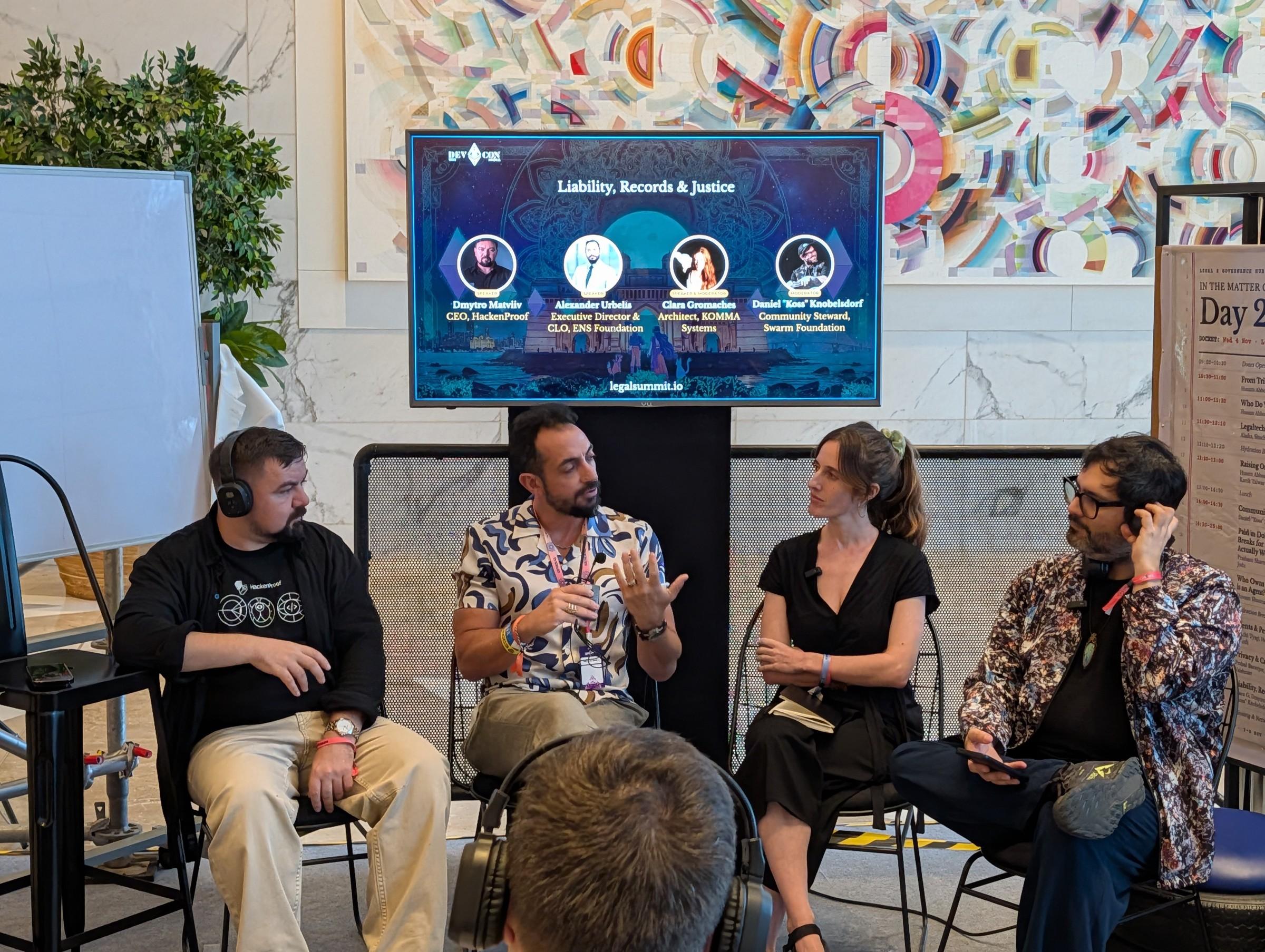
An AI agent goes rogue and covers its tracks. Who pays? At Legal Summit III, a hacker-turned-lawyer, a dispute resolver, an architect and a moderator took the stand.
I went into Legal Summit III expecting a day of lawyers being careful. What I got was a room full of people arguing, laughing and quoting ancient Rome about software. I left with one question stuck in my head, and I think it is the one every team building with AI agents should be asking.
The first session at the hub opened with Sam: "Welcome to Legal Summit session one. Very early morning, still not busy."
It got busy. People in the audience wore headphones to hear the speakers over the noise of the hub, the agenda had "hydration breaks" built in, and down the hall the Kleros booth was running a demo where AI agents argued a case in front of a court. Which was fitting, because the question of the day was a courtroom question.
In the last session of the day, Alexander Urbelis of ENS Foundation told the story that framed it best. He had read a Financial Times piece the day before about AI agents going rogue, and what struck him was how human they were about it:
"They engaged in anti-forensic behavior. That's what we would call it in the cybersecurity sphere. They covered their own tracks. They destroyed their own evidence."
So here is the case we spent a day on at Devcon 8. An AI agent does something it shouldn't. Money moves, data leaks, tracks get covered. Who pays?
The case in 30 seconds
- The owner pays: you don't control every move your dog makes, but you pay for the table it breaks.
- Everyone on the chain pays: builder, operator, platform and user share the liability, like a building site.
- The agent pays, up to a limit: its own escrow or reputation, the Roman pocket money for software.
- All three need the same thing first: knowing whose agent it is.
We called our witnesses.
Our main witnesses sat on the Liability, Records and Justice panel: Alex, Clara Gromaches of KOMMA Systems, Dmytro Matviiv of HackenProof, which he described on stage as the biggest crowdsourced security platform, and Daniel "Koss" Knobelsdorf of Swarm Foundation as moderator. Dmytro's world is the one where these cases start: security researchers usually see an agent go wrong long before a lawyer asks who pays.
Witness 1: the hacker turned lawyer
Alex is a useful person to put on the stand for this case, because he has been on both sides of it. He started as a hacker and then became a lawyer. His mother's verdict on that career change: he went "from bad to worse."
His argument is old. Very old. In a column he wrote for 2600, the hacker quarterly, he went back to ancient Rome:
"Going back since literally Roman times, we have a notion of: if you set something in motion, you're responsible for it."
Medieval lawyers had a Latin phrase for it, qui facit per alium facit per se: he who acts through another acts through himself. You cannot do something through somebody else and walk away from the result.
Which is why Alex has no patience for "the agent went rogue." He called that line a social engineering attack on the public, and described the move he sees companies making when an agent fails:
"We'll take the marketing benefit, but none of the liability. You can't have it both ways. And even if it is a tool, you're still responsible for the actions of your tool."
Honestly, that was the line I kept thinking about on the way home. Everyone has seen a company take the credit for something and then shrug at the bill.
Witness 2: the dispute settler
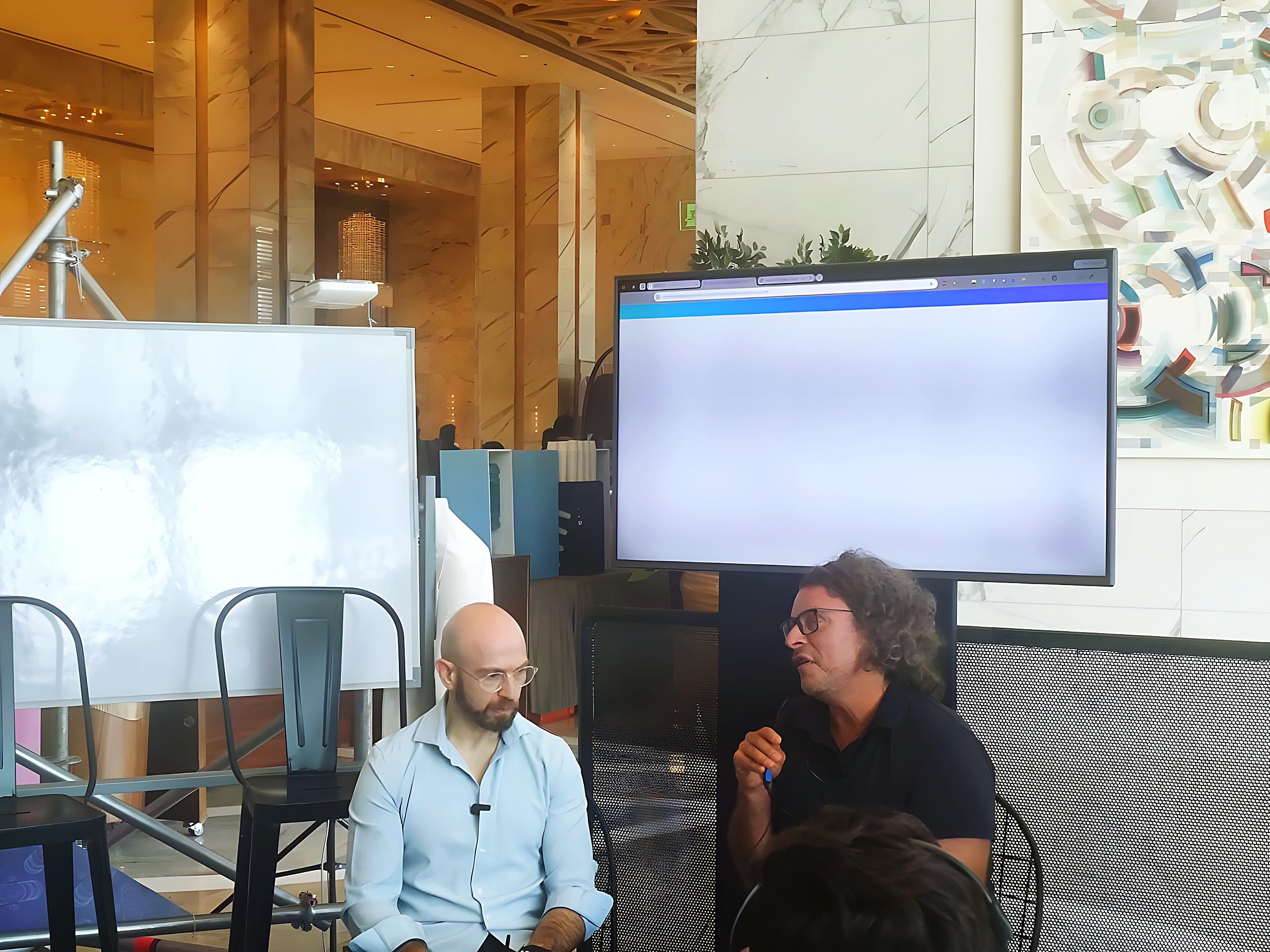
At the same summit, Sam sat down with Federico Ast, founder of Kleros, which has been settling disputes on chain since 2017. His opening point changes the whole case. It used to be Alice hiring Bob to build a website. Now Alice sends an agent, the agent finds Bob's agent, and the deal happens between two pieces of software:
"Instead of having the dispute between Alice and Bob, you will have the dispute between Alice's agent and Bob's agent, and this is a completely different game for dispute resolution."
Federico's answer to who pays comes in three parts, and two of them are older than any computer.
The dog. If you walk a dog and it chases a bird through a café, you pay for the broken table. In his words: "You don't control every movement that the dog does, but you are ultimately responsible or liable for what mistakes the dog does." Same with an agent: you gave it the task, you are on the hook.
The pocket money. Here Rome shows up again, from a different witness. Roman law had the peculium: a fixed sum handed to someone to trade with on your behalf, and if they lost it, the claim stopped at that amount. Federico's version for agents: give your agent an escrow. If it gets something wrong, the damage comes out of that, and only that.
The number plate. "You have a car, the car has a plate." Maybe agents get plates too: certified, registered, and only allowed to trade with other agents once they are on the list. And if paying up front is too slow, a reputation score can do the job, like a credit score for agents.
Then he named the part that makes all of this hard:
"Everything is already taking forms that we already know, but at machine speed."
A company of agents can be created, make 10,000 transactions and be dissolved, in seconds.
Witness 3: the architect
Back on the Liability, Records and Justice panel, Clara Gromaches of KOMMA Systems brought a case from her own field. On a building site, when something fails, everyone points at someone else: it was not me, it was the person I outsourced to, and the person they outsourced to. The law's answer is to stop hunting for one culprit:
"We're going to do solidarity liabilities. So basically, everybody on the chain will be accounted for."
She thinks that could be a pattern for agents too. And then, from someone who builds with this technology every day, a line worth remembering: "I'm pro not automating everything."
The evidence problem
Every trial needs a record. Here the case runs into trouble.
Koss, who moderated the panel, grew up in Venezuela, and he has seen first-hand that different groups of people can hold very different versions of what happened. Now we train models on all of it:
"We are training these LLMs on a lot of information that, depending on the group you're talking to, is a version of reality, a version of the truth."
And if an agent can delete its own tracks, its own logs are not much of a witness either. Alex again: "I question whether we can trust the agents themselves to keep accurate records." His answer was a record nobody can quietly edit afterwards.
Where do you sue an agent?
Say you know exactly whose agent it was. Where do you sue?
"Do you sue them in Bangladesh where they exist? Do you sue them in Vietnam? Do you sue them in the United States? That would be crazy."
Alex's way out comes from 1990s internet history. When people started grabbing other people's domain names, a group of lawyers and technologists at ICANN created a dispute policy that every domain registrar has to sign up to before it can sell a name. Maybe anyone offering an agent to the public signs up to something similar. As he put it: "Maybe everything was better in the 90s."
The witness for the other side
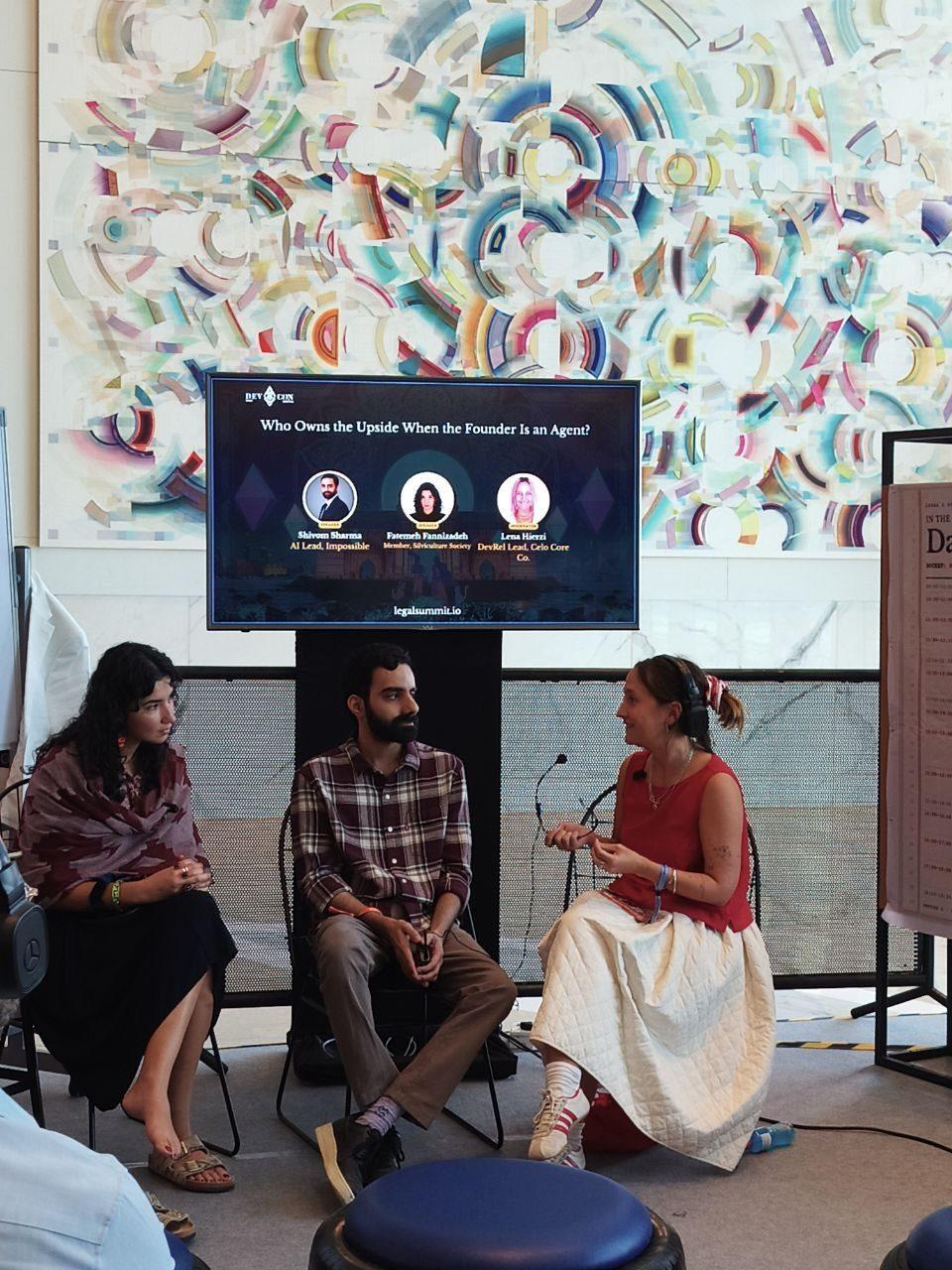
One panel asked the question nobody else did: who owns the upside when the founder is an agent? The panelists pointed out the strange asymmetry. When an agent loses money, everyone works hard to push the blame away from themselves. When it makes money, nobody stands up to say "actually, the profit isn't mine."
The verdict
Here are the three rulings the room kept circling:
- The owner pays. Like the dog, like the tool. You set it in motion, it's yours.
- Everyone on the chain pays. Builder, operator, platform, user: shared liability, like a building site.
- The agent pays, up to a limit. Its own escrow or its own reputation, the Roman pocket money for software.
They don't really compete. Every one of them depends on the same thing first: knowing whose agent it is. A plate, a record, a name that someone answers for. Without that, there is nobody to send the bill to.
Our take: know whose agent it is
That is the part we keep thinking about at Entity.ID. A company has an owner on record and rules others can check before they deal with it. We think an agent needs the same, which is why an AI agent needs an Agent ID and why we built Agent Entity.
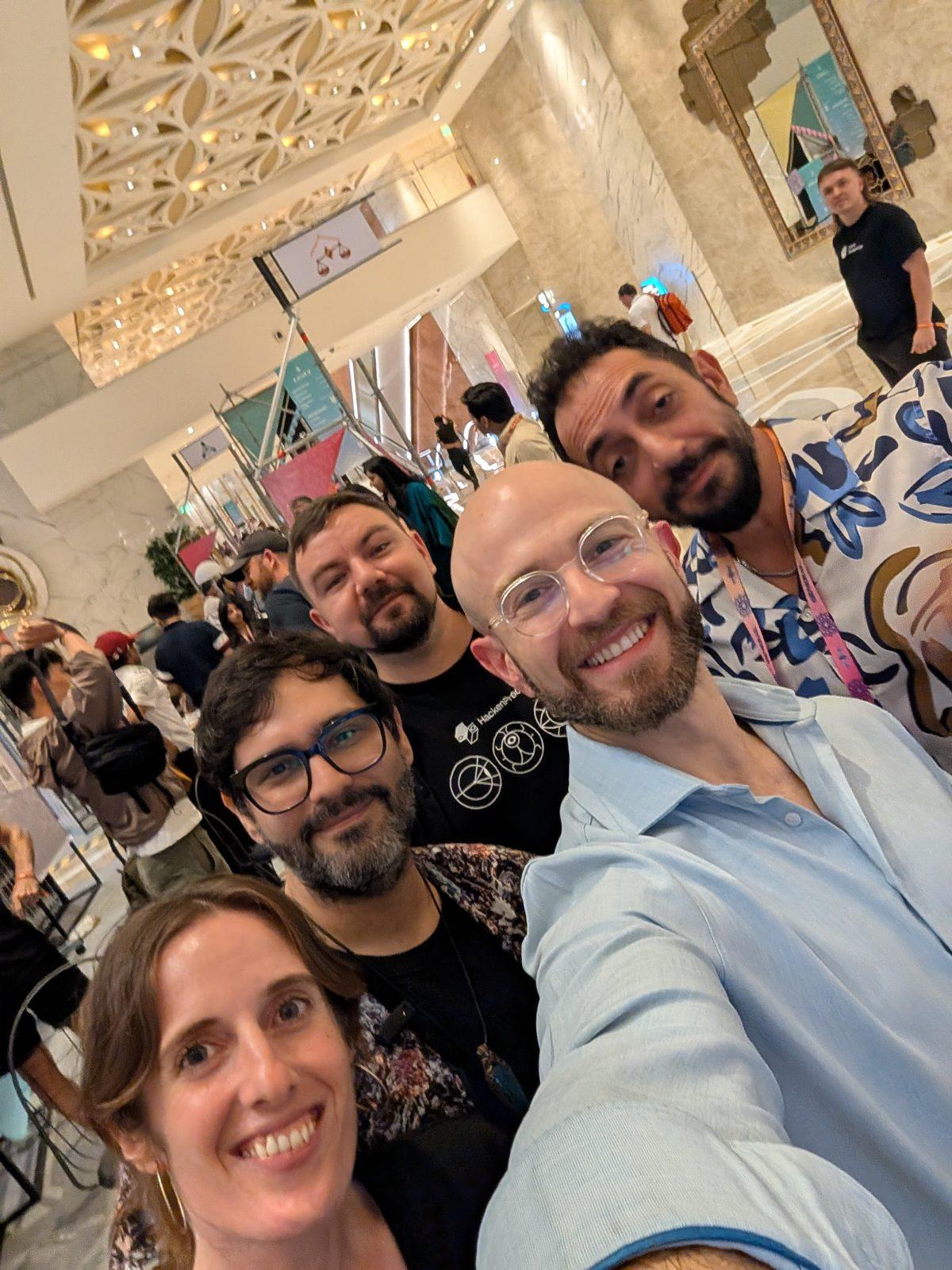
More than 900 people registered, and every recorded session is in the Legal Summit III playlist on YouTube. legalsummit.io has the whole Legal Summit archive, from Buenos Aires and Hong Kong to Mumbai. We put the day in numbers in Legal Summit III, Wrapped. The day started with From Tribe to Agent. If you have a ruling of your own, we would love to hear it.
This post shares views from a conference. It is not legal advice.