

Privacy for people, transparency for AI agents
Your chair has no right to privacy. Why the things people make, AI agents included, should show who is behind them.
Your chair has no right to privacy. Neither does your cow.
That is roughly how Sam put it on the last day of Devcon 8 in Mumbai, and it is less silly than it sounds. Rights, he said, exist because we are optimising for one thing: our own species surviving. So people have a right to own property, a right to speak and a right to privacy. The chair does not, because nobody is optimising for the chair.
It is a funny way into one of the most serious arguments about AI agents. If privacy is a right we give to people, what do we owe the things people make?
Privacy for born, transparency for made
Sam's answer is a motto he came back to more than once at Devcon:
"Privacy for born, transparency for made."
Anything born, meaning you, gets privacy by default. Anything made, meaning a company, a DAO or an AI agent, should be transparent by default, so the rest of us can deal with it safely.
Both halves have exceptions, and Sam names them too. A public figure gives up some privacy by stepping into public life. A made thing can keep plenty of its business to itself. But the default matters, because the default is what happens when nobody thinks about it. Today, for most AI agents, the default is that nobody knows anything.
Transparent does not mean naked
The fair objection: no company would agree to publish every invoice, so why should an agent?
It should not have to. The useful way to think about "transparent" is to split it in two. There is who stands behind something, and there is how it operates. Most companies already work this way. Their owners are on record, and their day-to-day business is private. Nobody knows what you paid your supplier, but anyone can find out who owns you. We walk through that map in old laws, new agents.
For an AI agent, the half that cannot be optional is the first one. Who is behind it. Everything else can stay private, as long as it can be proven when it matters.
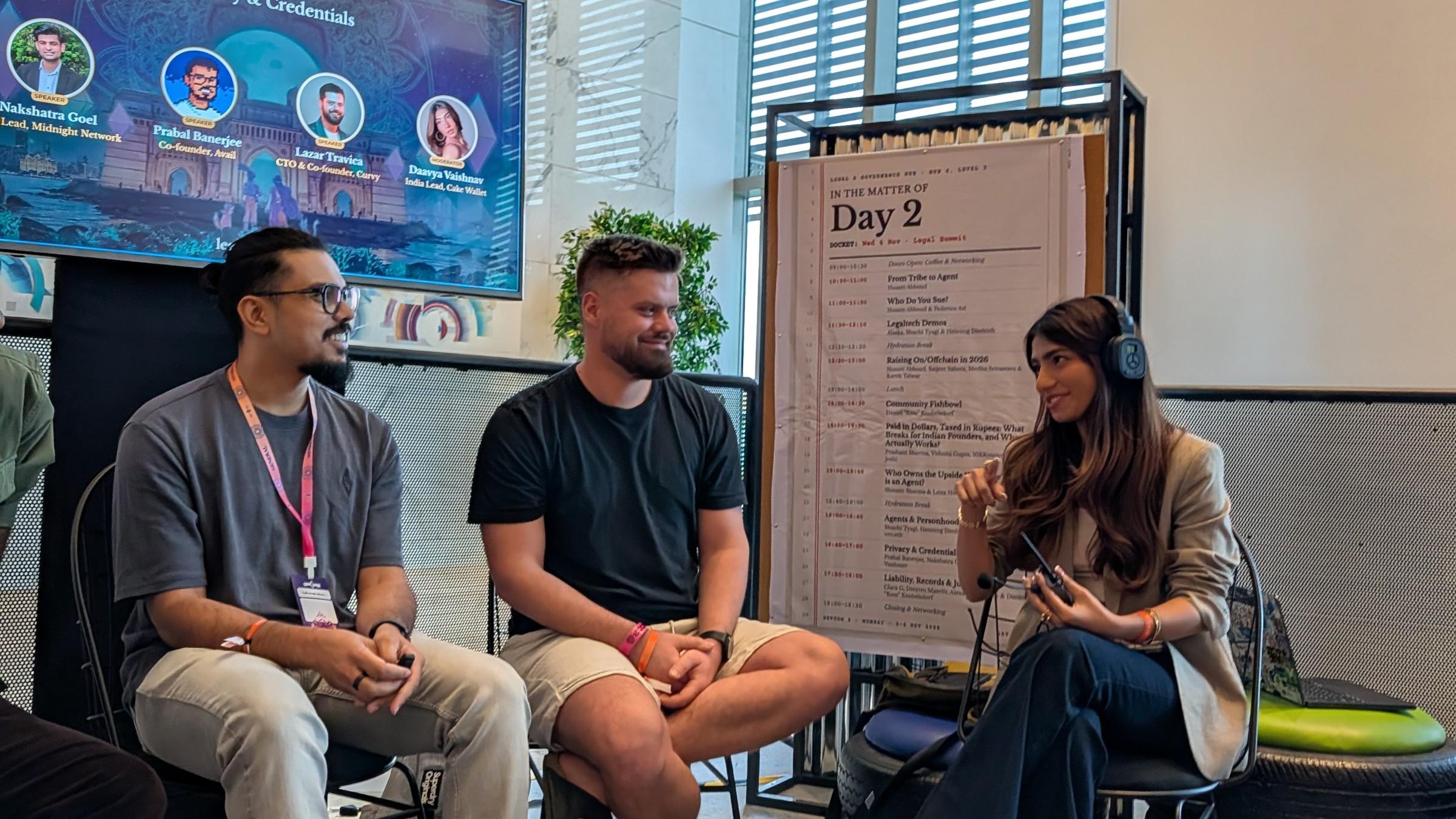
That was the mood of the privacy panel at Legal Summit III too. Asked what an onchain organisation should prove publicly, Lazar Travica of Curvy refused to pick one thing: "Everything should stay private by default." His point was that private and provable are not opposites. You can keep the parties and the amounts private and still prove the rules were followed, for example to a tax authority or an auditor who needs to see one transaction and nothing else.
The human behind can stay private too
Here is the part people usually get wrong. If every agent has to point to a person, doesn't every person end up public?
No. Pointing to a person and publishing that person are different things.
Think about how you prove your age at a bar. The bouncer needs to know you are over 18. They do not need your home address. The same idea works for agents. You prove who you are once, to an identity provider you choose and trust. The provider then vouches, publicly, that a verified human stands behind this agent. Anyone dealing with the agent can check that the vouching is real. Your name stays with the provider.
If something goes wrong badly enough that a court or regulator genuinely needs to know who you are, they know exactly where to ask. Everyone else just sees that someone answers for this agent, and that is all they need to see.
That is privacy for the born and transparency for the made, both at once.
Who holds the names matters
One warning from the same panel is worth keeping. If a single operator can see everything about everyone, the product is not really private, whatever it calls itself. It just moves your secrets to one company instead of spreading them around.
That is why we think the choice of identity provider has to belong to the person behind the agent. Not one gatekeeper for every agent on earth, but many trusted providers, and the freedom to pick the one you trust. A registry of who stands behind agents should never become a single list of everyone's names.
Would you share your salary?
The best moment of the privacy panel came right at the end. The moderator asked each speaker for one belief about privacy that most of the room would push back on.
One answer was that even law-abiding people need unconditional privacy. The argument against it always sounds reasonable: I am not doing anything wrong, so what do I have to hide? The panelist's point was that the real issue is not whether you want to do something wrong. It is whether you are still able to, and you only notice the difference once that freedom is gone.
Another panelist skipped the theory and turned to the audience instead. Imagine, they said, if I asked every one of you to share your salary right now.
That is the born half of Sam's motto in one question. Privacy is not a crypto feature or a web3 talking point. It is the reason you would not hand your payslip to a room full of strangers, even a friendly one. Nobody should have to give that up to put an AI agent to work.
Why this is urgent now
For most of history, the made things were slow. A company took weeks to set up and years to grow. You had time to find out who was behind it.
Agents are different. As Federico Ast of Kleros pointed out at the summit, a company of agents could be created, make 10,000 transactions and be gone within seconds. When something that fast goes wrong, "we will look into who owns it" is not good enough. The answer to who stands behind it has to be there before anyone needs it.
Our take
The rule fits in four words, and it is harder to build than it sounds. People get privacy. The things people make get a name on them.
An AI agent should always lead back to a person or a company that answers for it. That person should not have to hand their name to the whole internet to make that true. We think the basic facts of every entity belong on a record anyone can check, which is the idea behind existence should be a record you can check, and the rest can stay private until there is a reason. That balance is what we are building for with Entity.ID compliance.
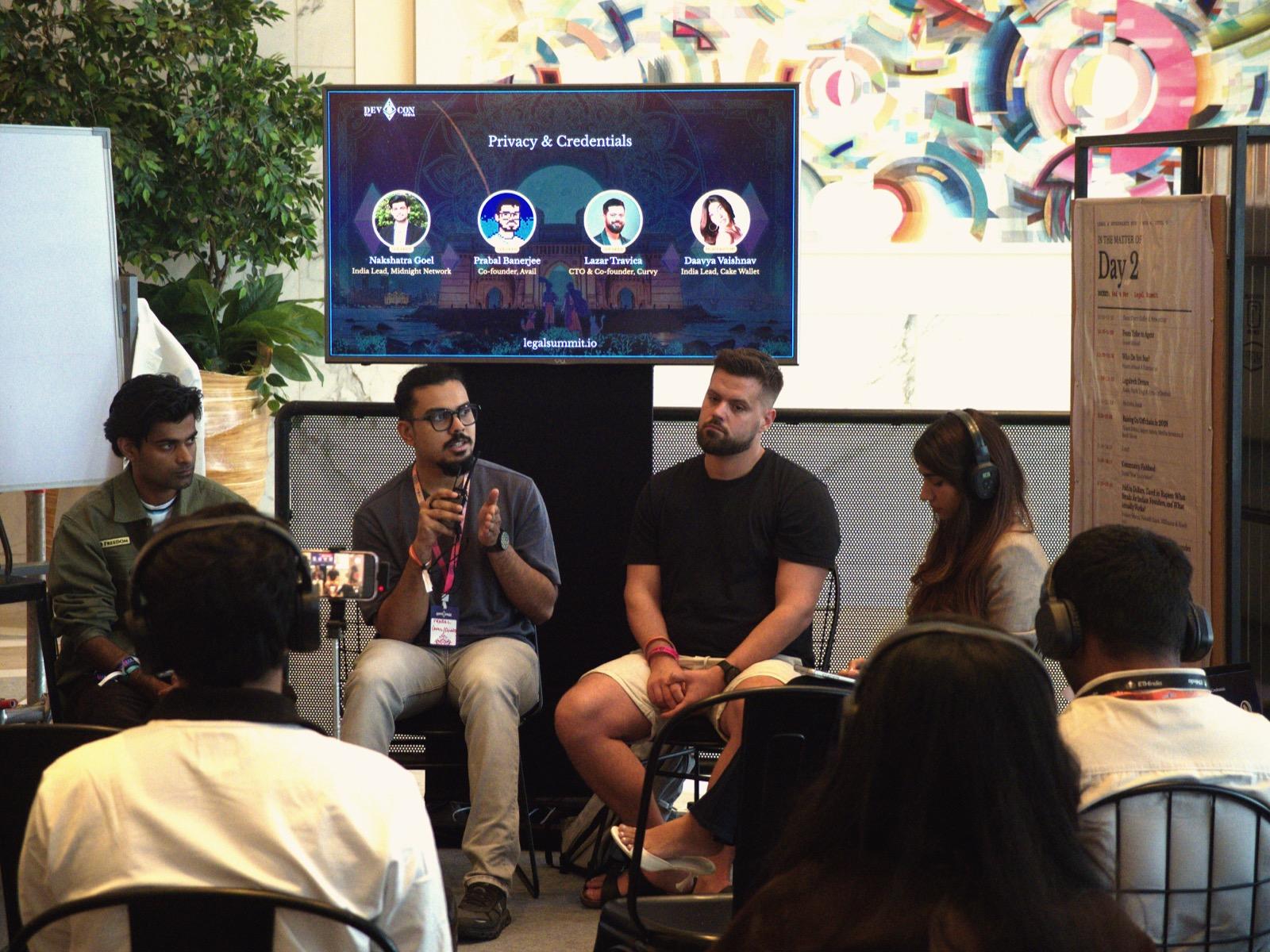
Watch the full Privacy and Credentials session with Lazar Travica, Prabal Banerjee of Avail, Nakshatra Goel of Midnight and moderator Daavya Vaishnav. For the rest of the summit, see Legal Summit III, Wrapped.
This post shares views from a conference session. It is not legal advice.