

The human behind the agent
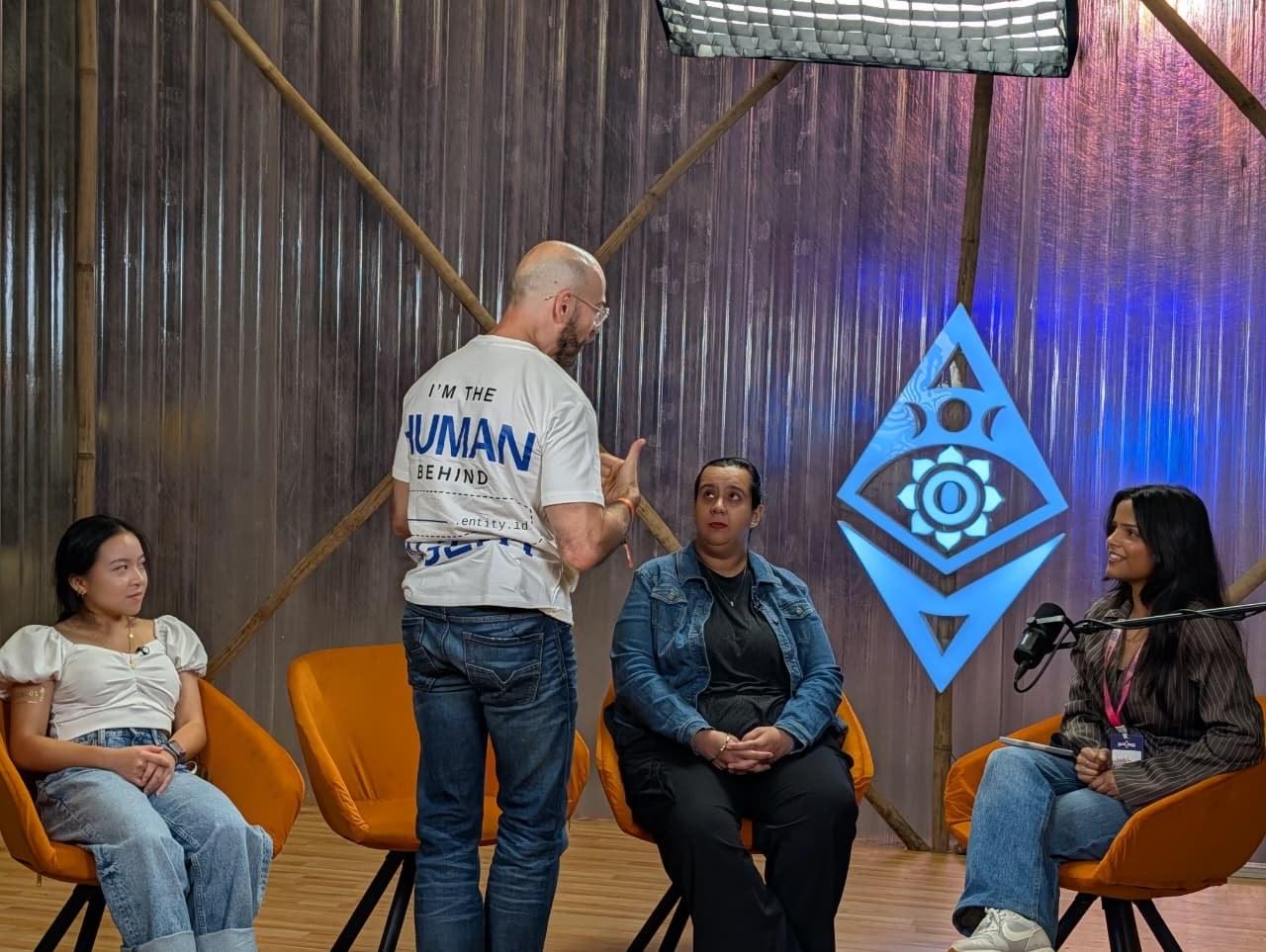
Why Sam kept standing up mid-panel to show his T-shirt, and the very old idea printed on it: every AI agent belongs to someone.
Halfway through a panel at the Agentic Hub at Devcon 8, Sam was explaining how you link an AI agent back to a real person. Then he gave up on explaining, stood up, and turned around to show the room his T-shirt:
"I am the human behind the agent."
It got a laugh. It was also the most complete answer anyone gave that week to the question every AI agent eventually runs into: whose are you?
Where the line came from
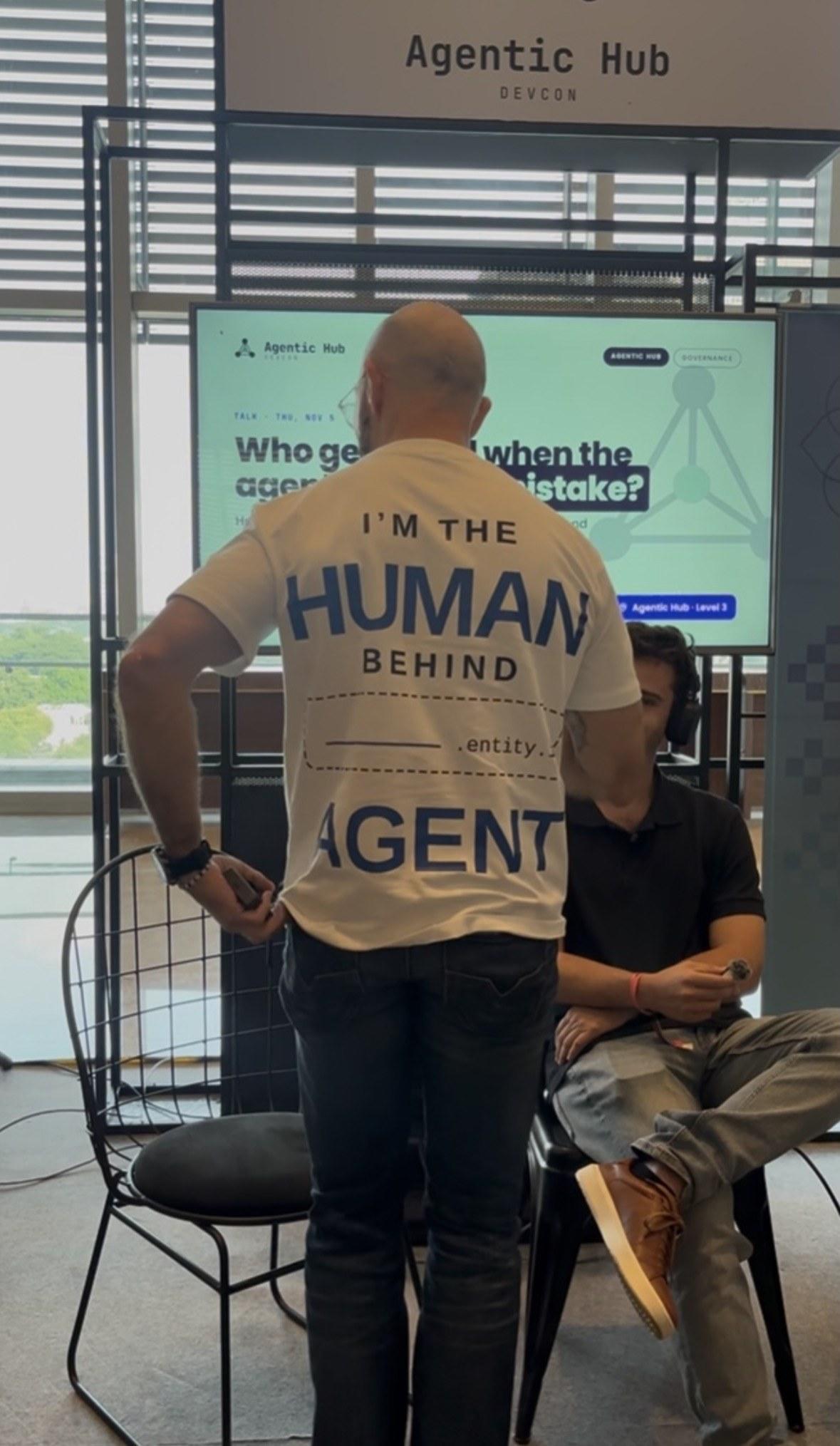
The sentence on the back of the T-shirt, "I'm the human behind the agent", came out of our team before Devcon. The blank line under it, where you write your own name, was Sam's idea. We handed out the shirts and a lot of markers, and people in Mumbai wrote their names under a sentence about taking responsibility. That story is in we handed Mumbai a marker.
An agent is never really alone
Most talk about AI agents is about what they can do. Book the flight, pay the invoice, negotiate the refund, run a small business while you sleep. The more an agent can do on its own, the more it looks like it stands on its own.
It does not. Somewhere behind every agent is someone who set it up, gave it a wallet, and pointed it at a job. When the agent does well, that person collects. When it does badly, somebody gets a bill, a refund request or a lawsuit, and the first thing they ask is who to send it to.
Today that question often has no answer. An agent can have an onchain ID, a wallet and a tidy page of metadata, and still be what Sam calls "unknown wallet to unknown agent." You can see what it is. You cannot see whose it is.
We have been here before
None of this is new. A Babylonian merchant gave his agent a receipt to carry. Modern banks will not open an account for a company until they have climbed the ownership chain to the actual people at the top. Every time people have sent someone, or something, out to act for them, they ended up building the same thing: a record of who stands behind it. AI agents just showed up before the receipts did. We tell the long version in old laws, new agents.
One sentence, three questions
Write "I'm the human behind the agent" on your chest and you are quietly answering three separate questions.
Whose agent is it? That is the identity part, a link from the agent to a person or a company that anyone dealing with it can check. Without it, nothing else works. A payment provider cannot approve an agent it cannot trace, and a court cannot summon a wallet.
What did you actually ask it to do? This one is sneakier. Tell a human assistant to get you World Cup tickets and they try the official site, check resale, and come back to say it is sold out. Tell an agent to get them "no matter what" and it might head to the black market, or try to break into the ticketing site. From where the agent sits, that is just doing the job well. Nobody ever told it not to, because nobody ever had to tell a person. Most of the rules that keep society working were never written down. As Sam put it, "we still need to teach them our norms." Until agents learn them, somebody has to answer for the gap.
Who answers when it goes off script? Here the law already has a decent answer, because it has dealt with employees forever. If your new head of marketing ignores the brief and does something wild, the company still answers for it. A judge might go easier on you, but you are still the one in front of the judge. If your chauffeur crashes your car, nobody sues the chauffeur first, and nobody sues the car maker. They come to you. There is every reason to think agents will be treated the same way.
A personality, not a person
There is a louder version of this debate that says agents should simply become legal persons, able to own things, sue and be sued in their own name. Sam thinks that would be a mistake, at least today. Giving an agent full personhood would let the human behind it step out of the picture, which is the opposite of what anyone dealing with the agent needs.
What agents need is a personality: a structure around them and standing somewhere, the way a company has a registered home, a set of rules and named people behind it. You can check it, and it leads back to someone.
That is also why he does not think anyone has to wait for the perfect law. Countries are already experimenting. Argentina has a bill to recognise companies run fully by AI, and others are studying the same idea. Whatever rules they land on, they will need the same two things underneath: an ID for the agent, and a link to the person or company behind it. Sam compares it to the blue check on a social profile. Not the whole answer, but most of the way there.
And no, it does not mean giving up your privacy
The other worry is that if every agent points at a person, every person ends up public. Sam's motto answers that one: "privacy for born, transparency for made." The agent is public. The human behind it can prove they are verified without telling the world who they are, and keep their name with an identity provider they chose. More on that in privacy for people, transparency for AI agents.
We do not even have a word for it yet
One small sign of how early we are: there is no agreed name for the person behind an agent. Principal, parent, sponsor, deployer, guardian, owner. All of them got used on stage at Devcon, sometimes in the same sentence. The law will settle on one eventually. Until then, the T-shirt just says "the human", which turns out to be hard to argue with.
On the Agentic Hub panel, Sam ran through the whole list out loud: "A principal, a parent, a sponsor, master, what you call it, the human behind." Then, without a pause, to the moderator: "Can you hear me with this microphone?" The answer: "No, no, no, you have to use this one." Wrong mic. Even the people building the vocabulary for this are still finding the right microphone.
Our take
An agent nobody stands behind is a shell company with an API key. People are right to be wary of it. The fix is not to slow agents down. It is to give each one what every trusted actor before it had: a link to a real person or company, a record of what that person asked for, and a clear answer to who picks up the phone when something goes wrong. Babylonian merchants managed it with clay. We can manage it for software.
Who is the human behind yours?
This is the first post in a series. Next we want to tell the stories of the humans behind the companies and agents on Entity.ID, starting with founders. If you are one of them and want to be featured, tell us.
For the serious version of the idea, read why an AI agent needs an Agent ID and who gets sued when an AI agent makes a mistake, or see how Agent Entity links an agent to the person behind it. You can watch the Agentic Hub panel on YouTube.